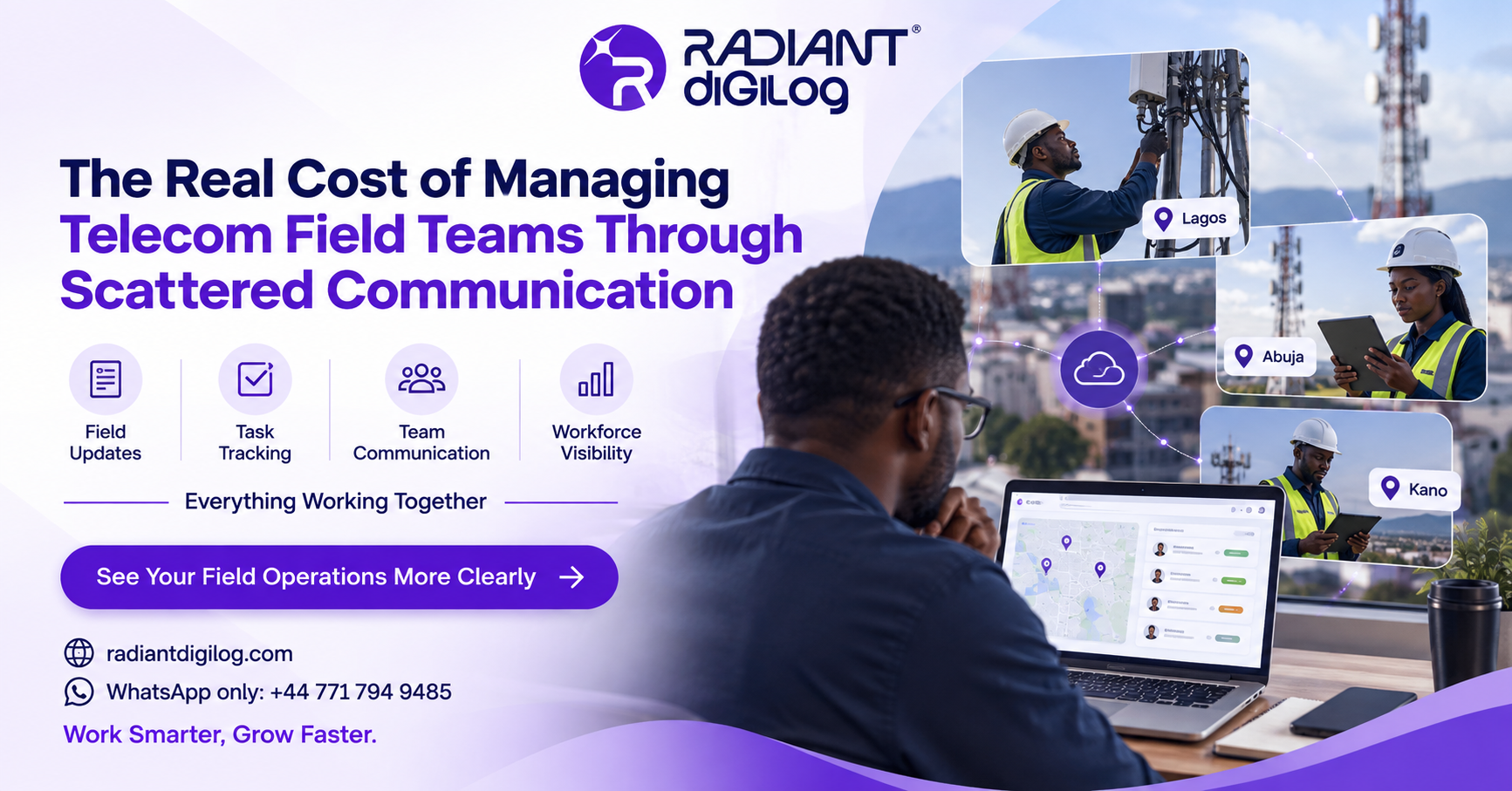
Field technicians move from site to site, supervisors coordinate from different locations, and network issues can appear at any moment. Keeping everyone aligned is not always as simple as making another call.
Telecom operations depend on people who are rarely in the same place.
A technician may be working on a tower site while a supervisor is travelling between locations and another team is responding to a network fault somewhere else. In that environment, phone calls and WhatsApp groups can become the easiest way to keep everyone in touch.
For a small operation, that may be enough.
The difficulty starts when the number of technicians, sites and daily assignments grows. More conversations mean more information to track, more updates to chase and more opportunities for something important to get lost.
The Problem With Updates That Disappear Into Conversations
A technician calls to report that a fault has been resolved.
The supervisor acknowledges it and moves on to the next issue.
But what happens to that update?
If it is not properly recorded, the information may remain in someone’s memory or disappear into a long chat thread. Later, another manager may need to know what happened, when the work was completed or who handled it, only to discover that finding the answer requires another call.
Over time, the organisation’s operational history becomes dependent on individual conversations rather than a reliable record.
-
“Done” Doesn’t Always Tell the Full Story
A WhatsApp message saying that a task is complete may provide an immediate update, but it does not necessarily give managers the full context.
Was the work completed on time? When was it finished? Was the technician actually on site? Does another team need to take action?
When field reporting depends heavily on messages and verbal updates, supervisors may have to follow up repeatedly before they can be confident about the status of a job.
That creates another problem: the more time spent confirming what has already been reported, the less time there is for planning and managing the operation itself.
-
When Supervisors Become Professional Follow-Up Managers
Consider a typical day.
A supervisor calls one technician for an update, checks a WhatsApp group for another, messages someone else about a delayed assignment and then tries to piece together the current status of several sites.
None of these tasks seems significant on its own.
Together, they consume hours.
Instead of concentrating on resource allocation, coverage, service issues and team performance, supervisors can end up spending much of their day reconstructing information that should already be visible.
That is not a people problem. It is a workflow problem.
A Clearer View of Field Operations
Phone calls and messaging apps are not the enemy. They are quick, familiar and useful for immediate communication.
The issue is relying on them as the main source of operational information when the team and workload have grown beyond what they can comfortably handle.
A connected workforce approach brings assignments, field updates, communication and operational information into one environment.
For telecom operators, that means supervisors can spend less time asking “What’s the status?” and more time deciding “What needs to happen next?”
They can get a clearer picture of which tasks are underway, what has been completed and where attention may be required without having to reconstruct the situation from separate conversations.
Better Visibility Starts With Better Coordination
Managing a distributed telecom workforce will always involve people working across different sites and locations. That complexity cannot be removed.
What can change is how easily information moves between those people.
When field updates are captured properly, communication is easier to follow and operational information is visible in one place, supervisors have a stronger foundation for making decisions.
The result is not simply fewer calls or messages.
It is a field operation where managers can see more of the work happening beyond their immediate view.
Radiant diGiLog helps telecom teams bring field coordination, communication and workforce visibility into one connected environment.
See your field operations more clearly.