Attendance records are only useful when organisations can trust them, verify them and act on what they show.
For a public-sector organisation with employees spread across departments and locations, knowing who is actually at work is more complicated than maintaining a list of names.
A register can show who is expected to be present. A spreadsheet can show who was marked present. Neither necessarily confirms who actually reported for work.
That distinction becomes increasingly important when attendance information is connected to payroll, workforce planning and public accountability.
When the Record Does Not Match Reality
Nigeria has seen several payroll verification exercises uncover discrepancies between official records and the people who can actually be verified.
In Rivers State, a 2026 biometric verification exercise found that 37,703 employees could be confirmed from roughly 43,000 names on the state’s civil service payroll, leaving more than 5,000 entries unverified. The exercise highlights the gap that can exist between a workforce record and the people physically accounted for.
The issue is bigger than identifying questionable payroll entries.
If attendance information cannot be verified, the same uncertainty can affect staffing decisions, payroll accuracy and management reporting.
One Organisation, Many Attendance Records
Public institutions rarely operate from one location.
Different departments, agencies and offices may maintain their own attendance processes. Some may use spreadsheets, while others rely on registers or locally maintained records.
Individually, these systems may appear manageable.
The difficulty starts when information needs to be brought together.
Head office may need to compare attendance across departments, locations or reporting periods, requiring staff to collect, reconcile and reformat information from different sources. The final picture is then assembled manually rather than generated from one consistent record.
Reporting Should Not Begin with a Data Hunt
Public-sector reporting often requires more detail than a simple attendance total.
Managers may need information by department, location, grade level or period. When those records are stored separately, every reporting cycle can become another exercise in finding missing information and checking whether different records agree.
That takes time that could be spent acting on the information instead of rebuilding it.
From Attendance Records to Workforce Visibility
Replacing an established attendance process across a large public organisation is not as simple as switching from paper to software. Many institutions have worked with manual registers and spreadsheets for years, making change a significant operational exercise.
The goal, however, is not simply to create another digital attendance sheet.
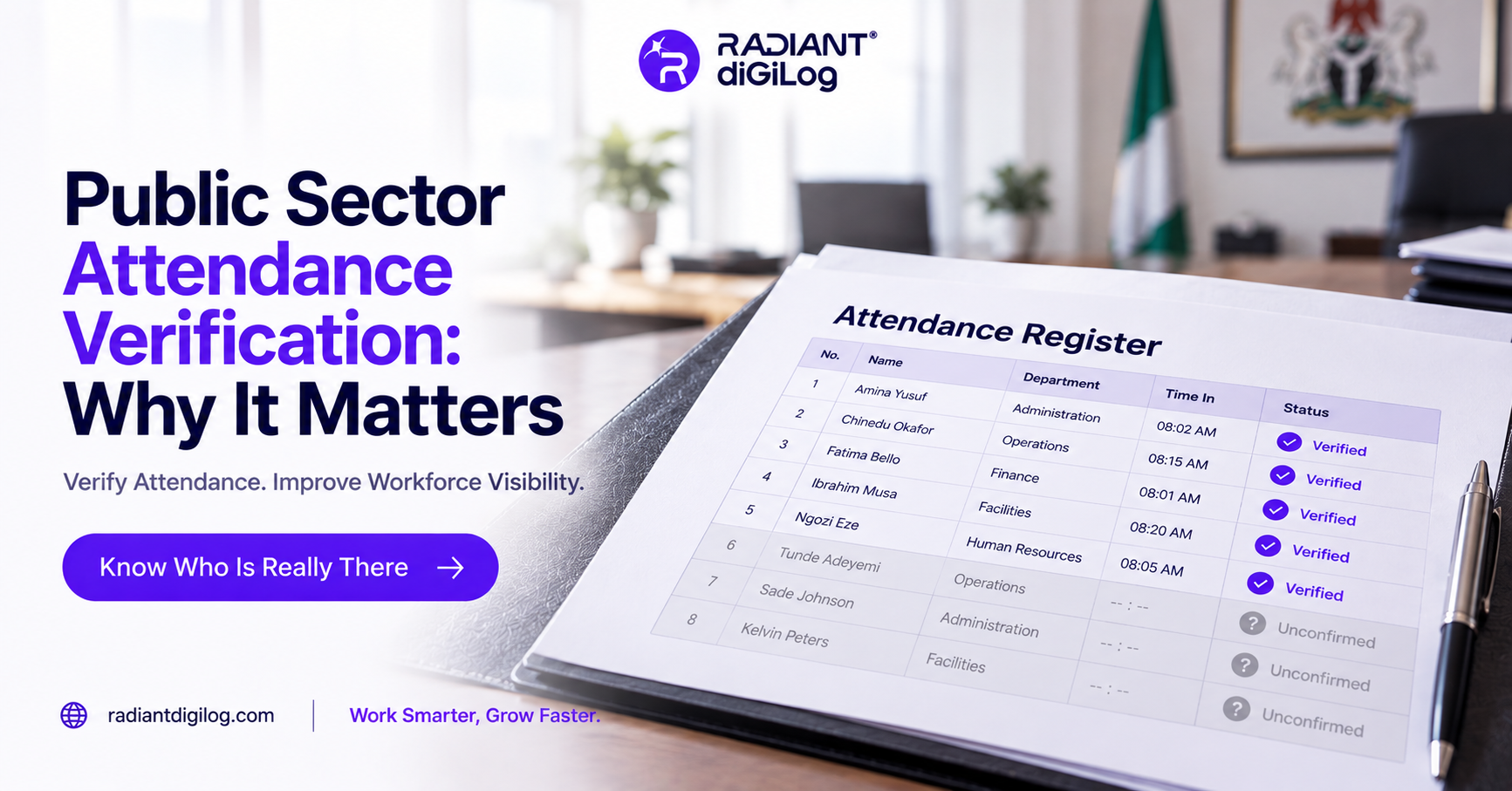
A connected workforce system can link verified attendance with staff records, reporting and a central operational view. Radiant diGiLog brings these elements together so managers can work with attendance information that has a verifiable record behind it rather than relying solely on manually entered entries.
For public-sector organisations, that means moving from “Who was marked present?” to a more useful question:
“Who was actually verified as present?”
Reliable attendance information gives managers a stronger foundation for payroll, workforce planning and reporting.
See how connected workforce management can improve attendance visibility across your organisation.